Back to the overview
We have more where that came from! Go back to the overview to discover all articles.
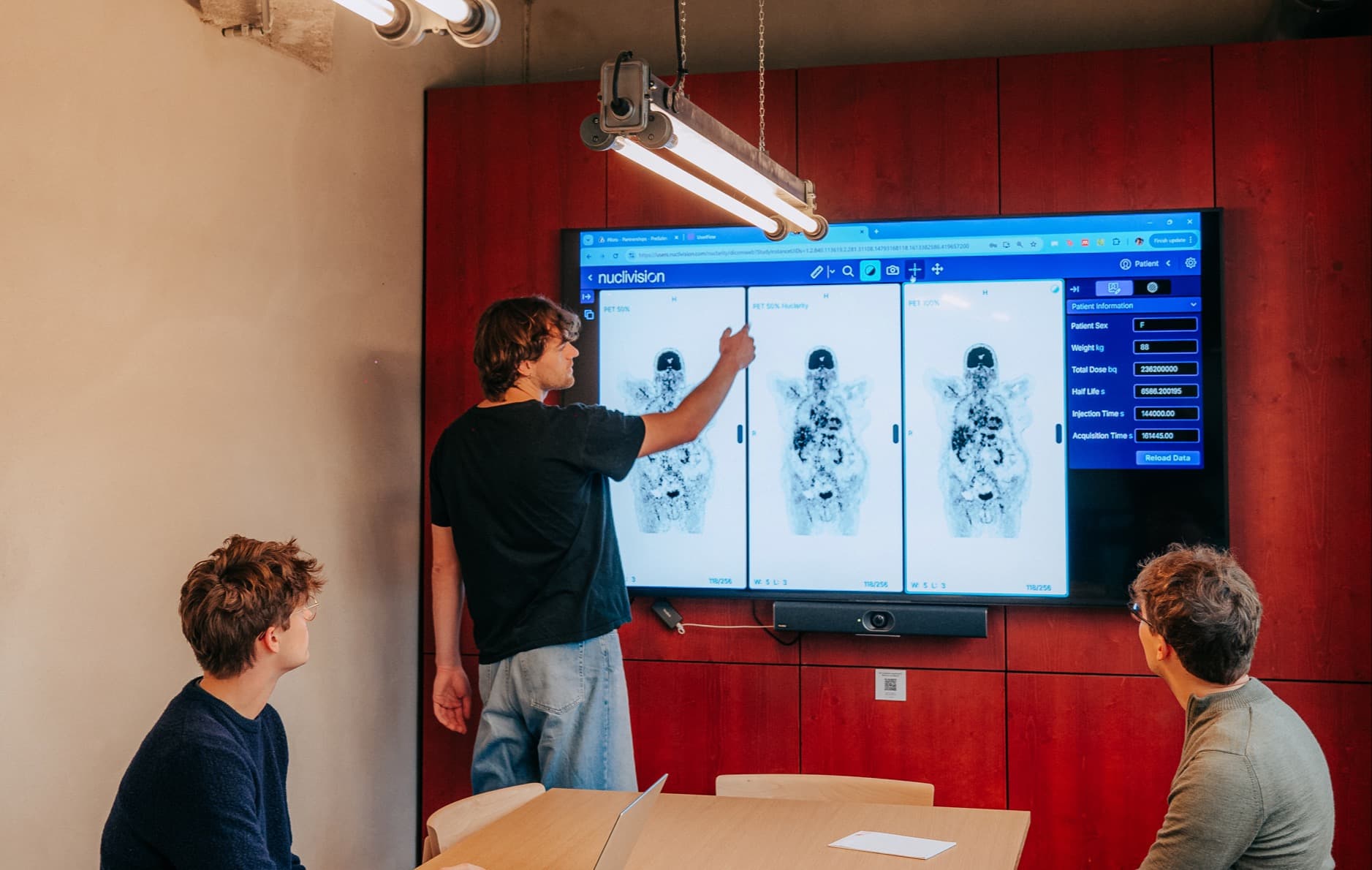
Nuclear imaging may very well be an invaluable tool for the early detection of cancer or even Alzheimer’s, but it’s also not very healthy and quite expensive. Luckily, Startup Campus resident Nuclivision has found a solution for that “while still detecting just as many tumors,” says CEO Maarten Larmuseau.
As approachable as everyone at the Startup Campus tends to be, it took some time to finally meet Maarten Larmuseau for coffee at Bakker Klaas, the artisan bakery at Wintercircus. “Truly sorry,” the nuclivision CEO fires off almost immediately, even before glancing at the menu, “but we are in the middle of a funding round.” When we point out that those are probably the two most popular words within the Wintercircus walls, next to ‘AI,’ he laughs and leans calmly against the back of his chair, seemingly for the first time that day. “It’s a hot topic here, for sure. Everyone is always raising money. But that’s part of it, of course. It’s one of the challenges of being a startup.”
Though by no means Nuclivision’s only challenge, as becomes clear during our conversation. Not least because the company operates in a particular niche: nuclear medicine. “And to say I don’t have a medical background,” says Maarten with a noticeable grin on his face. “I’m an engineer.” However, just as his co-founder, Tomas Brants, he wrote a master’s thesis on nuclear imaging, “at which point five nuclear physicians and professors asked us to join their startup and take charge of the technical development.”

Nuclivision's still relatively small team in one of the many Startup Campus meeting rooms The five initial founders aimed to develop a technology that would benefit both patients and hospitals. Nuclear imaging involves injecting a type of radioactive sugar that travels through the patient’s body. “It allows oncologists, for example, to detect tumors,” the engineer notes, “even before they show up on an MRI or CT. We know that tumors burn lots of sugar, so with nuclear imaging, you can see where your cellular metabolism is disrupted and - in not-so-medical terms - where something weird is happening in your body. The technology is also increasingly being used to detect Alzheimer’s and severe forms of rheumatoid arthritis, by the way.”
Except, the technology is not all that harmless to the patient - “injecting radioactive material obviously involves risks” - and it is also quite expensive and delicate. “The production of the nuclear tracer and its transport are tricky. The nuclear activity decreases so fast that when a supplier gets stuck in traffic, the last patients that day may not get a usable scan anymore.”
But that’s where Maarten and his team have found a solution. They developed a deep-learning algorithm that improves the image quality of nuclear scans so that even those last patients can still get one. Even more so, “each patient needs significantly less radioactive tracer, and our software also shortens the scanning process considerably. So it’s not just the patients who benefit; hospitals are financially incentivized to get on board too, because they can perform twice as many scans a day and still detect as many tumors!”

It almost goes without saying that there is much interest in the still relatively small startup Nuclivision, not just in Belgium. “Our intention is to take on the European market as soon as possible,” the CEO admits. “But for now, we’re sticking to pilot projects in hospitals just across the border with France and the Netherlands - places we can get to easily, in case there’s an issue.”
Maarten says they learn a lot from those pilots, “and the positive feedback we get from the hospitals and doctors involved is also extremely motivating.” But there is, in fact, another reason why Nuclivision is taking such a humble approach for now. “We develop medical software, so we have to wait for our CE certificate to really get the ball rolling. And Europe is quite stringent in that respect. And slow. The process can easily take up to three years. But so far, we’re on schedule. And once we get the certificate, we can start selling.” He pauses, however briefly. “I must admit it’s genuinely challenging for a startup to operate without any real revenue for more than two years. It creates a certain kind of stress, and it’s nice to now be able to talk with the other startups here at Wintercircus about that. Even nicer: until recently, we were the ones asking for advice, and now we’re increasingly able to give it ourselves. Because in the end, that’s what Wintercircus is all about.”

There were also other advantages for Nuclivision in moving into the Startup Campus. “We had been talking to a Dutch investor for a while, and we always had to go to the Netherlands for that,” Maarten remembers. “Suddenly, we found ourselves at Wintercircus: ‘Shall we come to Ghent for a change?’ Even the doctors we’re working with are impressed. We didn’t expect that. Wintercircus has become a criterion in record time, and not just in technology circles.”
With that CE certificate in mind, Maarten has also benefited tremendously from the sales masterclasses at Wintercircus. “And our CTO Simon DeKeyser has recently discovered the gym”, he adds. But that’s it, for now. “Believe it or not, but this is my first time at Bakker Klaas. Obviously, it doesn’t help that the coffee in the Startup Campus is free. But more importantly, I have devoted almost all of my time over the past few months to this funding round. Mind you, I’m not complaining! It’s all very exciting, and the medical community seems to really believe in what we have to offer.” He smiles. “But yeah, it’s a hard-knock life.”
And then it’s time for another call with a potential investor. Without ever having looked at Bakker Klaas’ menu, let alone tasting its delicious coffee, Maarten is off again. “One day I'll find out why everybody is talking about the focaccia in this place! Once things have calmed down.”
Want to know more about the Wintercircus Startup Campus? Visit wintercircus.be/campus

We have more where that came from! Go back to the overview to discover all articles.